The infamously-renowned Captain Silver was a pirate that traveled the Seven Seas and amassed an amazing fortune. Having since passed from this world, the location of his treasure remained a mystery... until now. A young lad named Jim has been given a map to the whereabouts of Silver's riches by an elderly fellow, and sets out on a journey to nab this wealth for himself. However, the old man gave him a grisly warning before departing: beasts, pirates, monsters, and all types of unnatural beings stand in his path to Captain Silver's possessions. But with a cutlass in hand, the bold explorer goes forth, with his first destination being a port town.
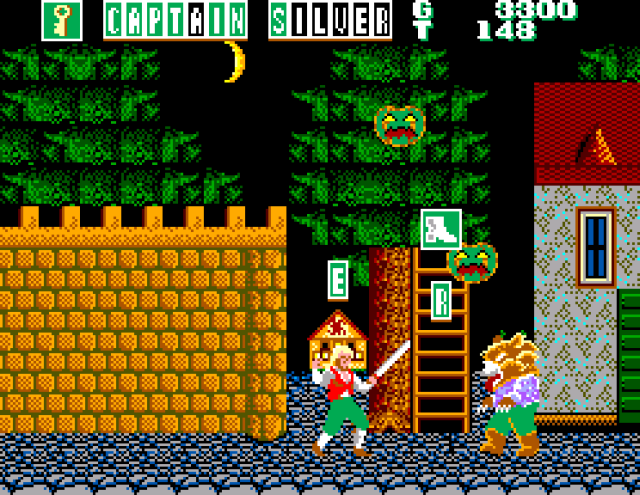
On its surface, gameplay appears to be a deceptively simple side-scroller based on the contents of its first stage. As you push Jim forward into the town at night, you encounter werewolves with giant heads, literal purple Cheshire Cats who leap from ledges, and jack-o'-lanterns that fall from trees; all three enemy types simply gravitate towards you and can be taken out with a single swipe. Shortly into the stage, you can grab a flying Sprite and power up your cutlass, allowing you to cast a projectile and keep most enemies at a distance. Lastly, every single enemy drops a green card with a letter on it, and if you manage to collect all the letters that spell out CAPTAIN SILVER, you gain an extra life.
 Credit: SEGA
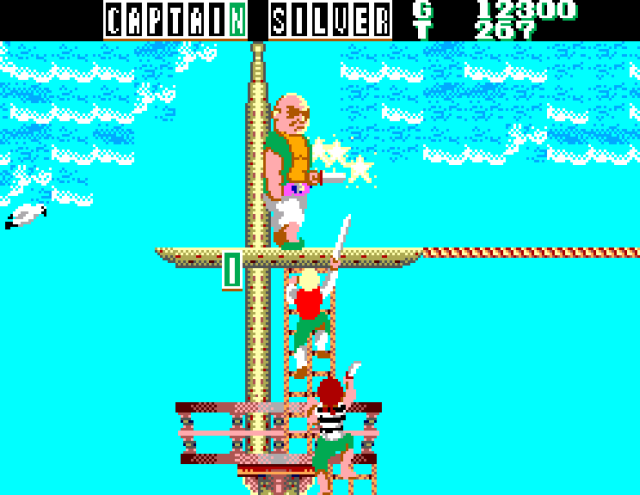 Credit: SEGA
But Captain Silver originated as an arcade title from the latter 1980s, meaning that, despite being six stages long, it is structured to keep you replaying until you're "seasoned" enough to beat it. One way is simply making you die by getting hit once. Early one-hit melee foes make this a trivial concept, but before the first stage ends, you're confronted by a slew of flying enemies that throw projectiles. If you don't have your own projectile item, this can be tricky up close, especially since bumping into them immediately kills you; worse, your projectile will be discarded when spawning at a checkpoint.
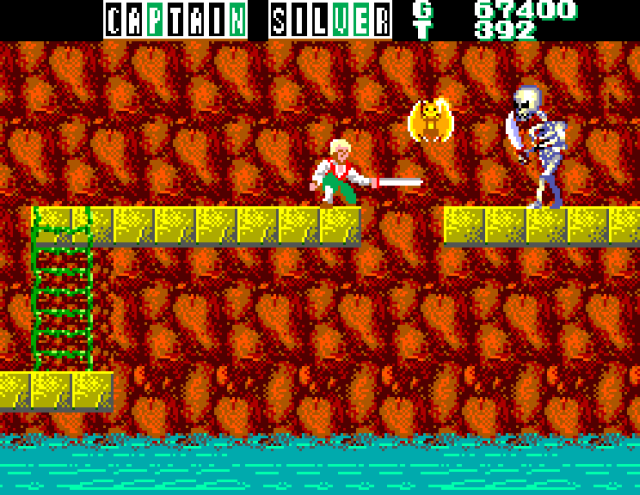
These confrontations become normal as you make progress throughout: pirates fire guns, bigger pirates throw knives, birds fly in Medusa Head-like patterns, and island natives shoot arrows. Adding to the tension is the fact that some opponents, like the skeleton warriors in a cave, take multiple hits to down, which can be touchy since these types attempt to walk into you. You can circumvent this by backing up after a hit or two... but you better hope that other enemies aren't nearby.
Most video games make you learn how enemies function in order to advance. This is normal, however Captain Silver's one-hit death, quarter-crunching method may be off-putting to some; there are people who aren't accustomed to the oldschool method of dissecting each enemy encounter at the risk of losing a life, and then restarting at a checkpoint or getting a game over. In a badly-designed game, this is disastrous, but this one actually gives you a fair chance with decent enemy placement and power-up usage. Projectile powers can actually be stacked, turning your single-file cutlass shooter into a five-way spread, and there's also a power-up that allows you to sustain an extra hit, though pits and "walkthroughs" are exceptions. It doesn't hurt that you can also buy these items at a shop per stage.
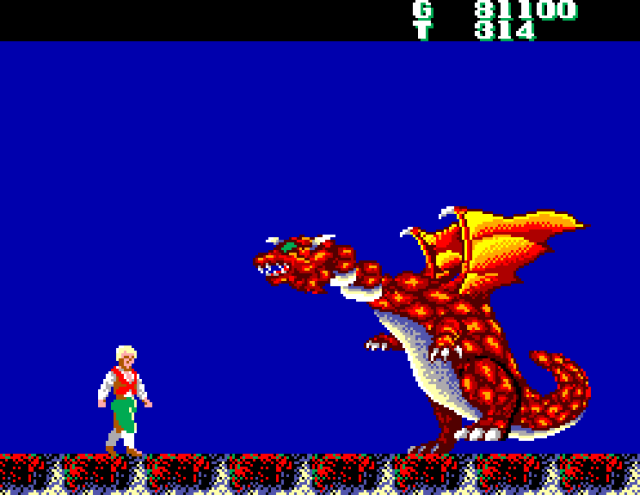 Credit: SEGA
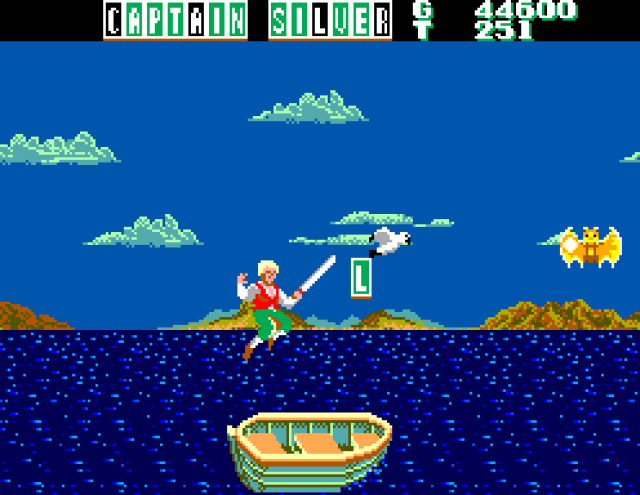 Credit: SEGA
Though, perhaps the most fascinating tidbit is what happened to this SMS port when released in different regions, which is probably more intriguing than the game itself. First coming out in Japan and followed by a European release, the game's overall package features six stages with six different boss fights. But then comes the US release near the end of 1989, which has been drastically modified: two stages have been omitted, one half of the last stage has been removed, the ending sequence is now just a text crawl, and the town and jungle bosses have been cut. For the latter, those stages end without a confrontation. While there has never been an official explanation, the main theory is that one-megabit cartridges were used to cut down on costs.
Does that make the EU version worth experiencing? Well, if you're determined to play it regardless of quality, then of course; the butchered US release is like playing a bizarre Twilight Zone version of something that shouldn't exist. As for the actual quality of gameplay, it's a decent side-scroller, mainly saved by its oldschool arcade difficulty which surprisingly doesn't go overboard; the worst that it ever gets is three intentionally-awful enemy fish placements in stage five. If you don't mind having to methodically make it through the game, while enduring one-hit deaths and using a cheat code for limited continues, Captain Silver will briefly occupy your time.