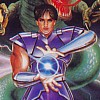
Woody Pop has an intriguing release history for something that's an innocuous title. Originally published in 1987 for the Mark III, the Japanese equivalent of the Master System, the game was released as a budget MyCard, due to the product itself not requiring much memory for a traditional cartridge. Also, with it being a block breaker title, where you continuously use a paddle to knock a roaming ball into breakable objects, Sega made it compatible with their Paddle Control. There's a catch: it is compatible with the paddle exclusively. So if you bought the game used and wasn't aware it came packaged with the controller, then... well, how badly do you want to play a Breakout-style game for your Mark III?
However in 1991, Woody Pop not only got a second chance on Sega's Game Gear, but it is no longer trapped behind an alternative controller. Best of all, this iteration received an international release, meaning people around the world finally got a chance to play a, um... a paddle-and-ball game. While some would find delight in that, you have to keep in mind that this came out during the early 1990s, when action games and platformers were popular choices for "console" gaming; the block breaker genre wasn't exactly in high demand during this period.
 Credit: SEGA
 Credit: SEGA
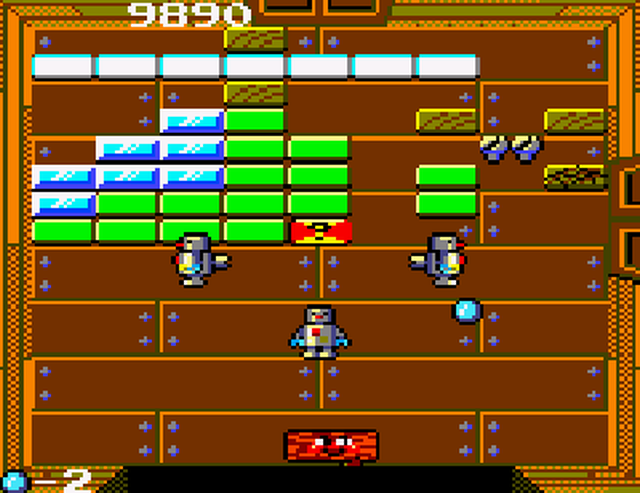
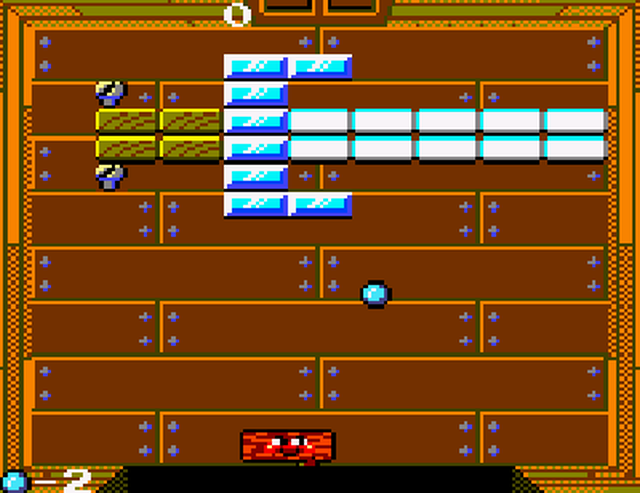
But regardless, the game is a serviceable addition to the genre that also includes interesting new aspects to the template. The core of Breakout applies here, where you must destroy all breakable blocks inside a room to advance, and do so while preventing the ball from falling down a pit behind your paddle. What makes this tricky is how, the longer you keep the ball in play, the faster it gradually becomes. Woody Pop's original 1987 release date should especially be noted, as the smash hit Arkanoid came out only a year prior; with that in mind, the game takes certain elements from Taito's influential ball-and-paddle product. Because why wouldn't you copy elements from a current hit game?
The most blatant of these is being able to grab power-ups that fall from special blocks: abilities like having two balls in play, enlarging the ball, or strengthening the ball to break through any block in one shot. The latter is helpful for destroying wooden blocks, which normally take multiple hits, and a blessing when dealing with the usually indestructible Question Mark blocks. The "?" blocks, when your ball collides with them, will either unleash three toy soldiers or robots. Your ball can destroy them, but they will be a temporary nuisance as they randomly roam the field, getting in your way.
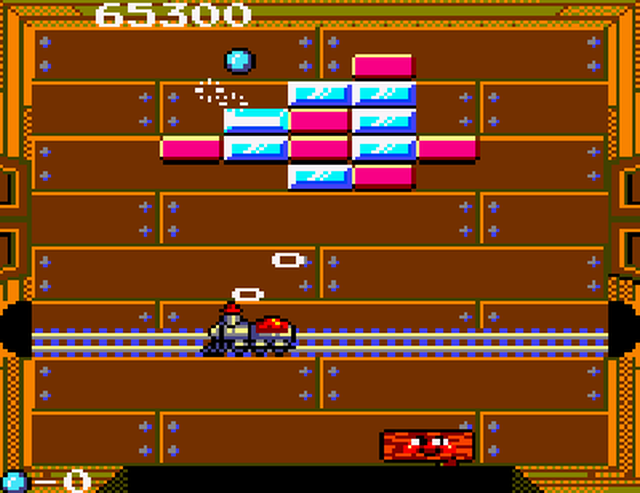
Taking another nod from Arkanoid, most stages in Woody Pop have unique block layouts, though some use the default "wall" designs from Breakout. From cocktails and ships, to pointy crowns and swords, a lot of these are created in a way where, if you knock the ball into a small crack and get it in the top corner, you can destroy most blocks in rapid succession. Though, perhaps the most interesting aspect this game does with stages is the way you approach them; in many cases, once you complete a stage, you are given the option of going through one of two doors, each one leading to a completely different stage. While pathways temporarily converge into a "corridor" stage, the fact that not every playthrough won't be the same is a commendable attempt at variety for a paddle-and-ball game.
 Credit: SEGA
 Credit: SEGA
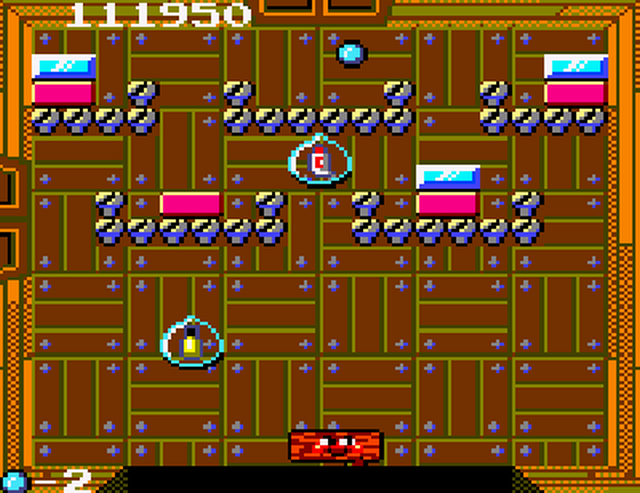
Aside from the "?" foes, there's other obstacles that get in the way. For example, one "power-up" widens the pit, and in a few stages, there's a locomotive that pops out of tunnels, acting as a deflector. However, there's one hazard that will irritate you the most: nail blocks. These shatter-resistant blocks start out as minor nuisances, having inconsequential placements, but they become downright frustrating when later stages are littered with them. There's two major problems when this happens; the first is that, due to certain layouts, a ball can get stuck in a corner for a long time, slowly inching out of its entrapment; the second is the consequence of the first, as your ball just gets faster and faster... until it bursts out of the corner and breaks the sound barrier. You know what happens next.
Thankfully, you're granted unlimited continues and, 99.99% of the time, you spawn back into the stage you failed in. And graciously, the nail-focused stages are few and far, but you can't help but groan when you encounter one, as you know it's going to be a war of attrition. But if you set aside those irritating stages for a moment, Woody Pop does enough right things... mostly because it took inspiration from Arkanoid... to make it a nice addition to your library if you are even remotely interested in block breaker titles. Just know that you're getting into traditional hand-eye coordinated gameplay, and you'll have a nice time-waster on your hands when you accept that.