
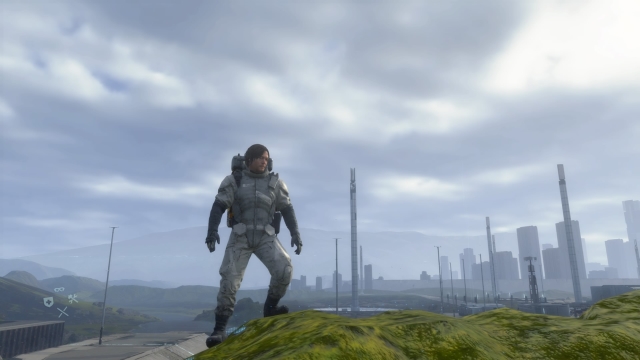
Contact; the method which people share knowledge with one another, and in doing so, often made great strides throughout history. However, with contact also comes the possibility of conflicts, wars, and disasters. As the game opens, the world is in a cataclysmic state; an "incident" was triggered a generation prior, the Death Stranding, and now the biosphere is in disarray. Any contact with rain or snow, now called Timefall, rapidly ages anything it comes into contact with when not covered in special material. If that's not bad enough, there's also the matter of Beached Things, or BTs, which are ominous, oily figures that appear in heavy Timefall. It gets worse: if just one human gets eaten by a BT, they cause a Voidout, which is the equivalent of setting off a nuclear bomb. Unsurprisingly, huge sections of the United States now live in underground bunkers in fear, with no contact with the outside world.
This is where your protagonist, Sam Porters, comes into play. Being a porter, a person contracted to deliver essential cargo, Sam is required to navigate vast regions of dangerous territory full of bumpy, uneven terrain, BTs, and other potential hazards. As you eventually gain control of Sam, the game immediately puts you in a scenario where materials must be carried to a nearby city on the east coast. A simple Point A to Point B task? Not necessarily, as demonstrated once you actually try moving around the landscape; with cargo on your back, you will tilt, you will trip, you will stumble nearly every step, attempting to maintain balance with the L2 and R2 buttons. And hopefully, you will avoid the final possibility, which is falling on your face, dropping and damaging luggage. Also, items degrade when in continual contact with Timefall, so you literally can't move at a snail's pace.
 Credit: Kojima Productions/Sony Interactive Entertainment
See that long, snowy, mountainous area in the back? You have to climb that at some point.
Once you complete that initial delivery, a grand objective is imposed on Sam: travel the continental United States, reconnect every underground city and bunker to a single network, and, according to the organization you "made" a contract with, make America whole again in the process. This is Death Stranding's core gameplay. This is what you'll be doing for the next 40-to-80 hours of play time. That probably sounds disconcerting, especially for something that seems like a delivery man simulator. However, Kojima Productions have turned this concept, a concept that's usually tame in other games, into a legitimately-engaging and challenging venture within Death Stranding's universe.
For instance, you will encounter sections littered with BTs, beings that won't become visible until you get real close. In true Hideo Kojima fashion, you're encouraged to avoid combat, instead choosing to sneak past them quietly, holding your breath, and using a "radar" system; failing to do this, being found and caught, triggers a nightmare-ish scenario in which the ground turns to oil and becomes difficult to run on, and where a ghastly beast makes its appearance. All this while also trying to prevent your haul from decaying and falling. Then there's portions of land patrolled by MULEs, porters turned thieves, who want nothing but to steal your cargo, doing so with electric rods and weapons that snatch items from a distance. You can kill them, but there's a price: you have to transport their bodies to one of only two incinerator facilities to stop them from turning into BTs and eating another human, thus preventing a Voidout.
However, even after playing for hours, after confronting several BTs, MULEs, and things more grand during your journey, you will come to a realization: your greatest rival is still the terrain. You could be struggling with a MULE group or BTs, coming close to losing your last inch of health, yet the main worry on your mind in those instances would be, "Please don't trip and lose items." Over time, you will have a better grip on controlling and more comfortable methods of traveling, but the moment you run into a bit of trouble, such as your bike on the verge of breaking down, a little bit of fear creeps in; the last thing you want is to be on foot, miles from any refuge, with literally 15 cases of cargo strapped to your body in unknown territory. And you know what? It's an exciting experience.
 Credit: Kojima Productions/Sony Interactive Entertainment
Despite the implication that you'll be doing all this by yourself, a "loose" multiplayer component ensures the opposite; as you open more of the network, several new items will be available to you, and along with that, you'll start seeing other player structures and items scattered everywhere. That truck you purchased is about to run out of energy? Thankfully, a charging station was planted nearby. Ran out of useful items? Check out a depot erected prior to entering a dangerous area and hope someone made a donation. This ties in nicely to Death Stranding's central theme of connections, as you and complete strangers help one another inch closer to the finale. Now, you're not obligated to help others with donations and repairs to their structures, but you'd be surprised how much aid you might actually need during your expedition. And if you're hellbent on not going along with the entire concept of the game, there's an option to switch off the multiplayer aspect.
Of course, as the game was crafted by Hideo Kojima, there's a plot, and if you've experienced at least one of his games, then you know his plots have an absurd amount of depth to them; Death Stranding is no exception, filling cutscenes with excessive details, and if you're in need of more, there's countless in-game emails and interviews that flesh out the world. Though, regardless of the abundance of story, you might be surprised to hear the game is "lean" when compared to his past works. However, that's likely because Death Stranding is a new IP that's not bogged down to an existing universe.
Some might argue that the light plot makes this one of Kojima's more weaker outputs in recent memory, but that really comes down to how you feel a story should be presented in a video game. In Death Stranding's case, the plot almost takes a backseat to the gameplay, which is a weird thing to say about a Kojima product. In spite of how the plot is showcased, it definitely didn't stop Kojima from injecting his trademark goofy, often fourth-wall breaking humor. Whether it be blatant product advertisement with close up shots of Monster drinks or literal shout outs to Norman Reedus' travel show, numerous film and video game industry cameos, or just Kojima purposely being weird for the sake of being weird, it's in here. If you don't like this, that's completely understandable, but at the same time, Kojima's been doing this with his games since the 1980s, so you shouldn't be surprised, either.
 Credit: Kojima Productions/Sony Interactive Entertainment
At a distance, Death Stranding just feels like a difficult recommendation, even with Hideo Kojima's name attached to it. When you watch trailers or someone streaming the game, the concept of traveling and balancing feels very understated because it looks like something generic transformed into a full-length product. But actually playing the game, you get a different sensation, one in which moving across rocky surfaces, carefully through BT-infested areas, and down several high mountains using consumable equipment, while tricky, lend a legitimate feeling of satisfaction when you overcome them. Boldly stepping into new territory also gives off a genuine sense of awe and wonder, especially when you laboriously climb up an extremely steep mountain, anxiously excited to see what's on the other side. There's an authentic sense of adventure here that you don't feel with many other open world titles.
If you have the patience for a lengthy game and itching for something different from the norm, Death Stranding is willing to fill that need. At the very least, it's certain to give you a unique and strange journey.