
 Credit: Wolf Team/Renovation Products/Telenet
Released within a year of the messy Earnest Evans, Wolf Team's El Viento has gathered somewhat of a cult following. Despite being less of a dumpster fire than its predecessor, El Viento's absence of polish in almost every conceivable regard proved insufficient to appeal to me. However, Wolf Team seemed to put more into this project than their last platformer, making it saddening that a similar degree of skill in game design wasn't employed, as well.
Anime-style cutscenes introduce us to the game, as well as some of its problems. Instead of revealing protagonist Annet's blood ties to an ancient evil and the one preparing to summon it as a twist, El Viento explains everything out of the gate, leaving almost no more events to transpire and dashing any opportunity to make a plot found in almost every anime meaningful. After the game spoon-feeds us exposition and explains that a mob boss somehow managed to unite several religions somehow in order to help summon Hastur somehow, vain villainess/dupe Restiana asks her sister why she won't help summon a demon sharing a name with a Lovecraftian outer god.
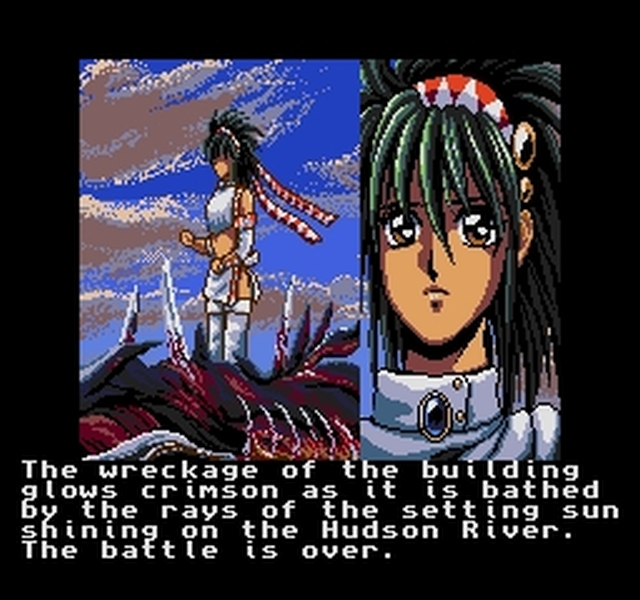
"Because you and I are human beings," Annet responds. Not exactly Sorkin-tier writing. The plot is a pulp of unremarkable anime tropes, but any narrative was appreciable for a action game in 1991. Completing a level may earn you a cutscene with some Valis-esque neat artwork to serve as a reward for overcoming an arduous challenge and a means for the player to become invested, even if the goings-on are as dry as it gets. Unfortunately, the cutscenes are as appealing as the visuals get here.
 Credit: Wolf Team/Renovation Products/Telenet
 Credit: Wolf Team/Renovation Products/Telenet
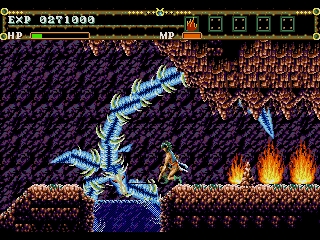
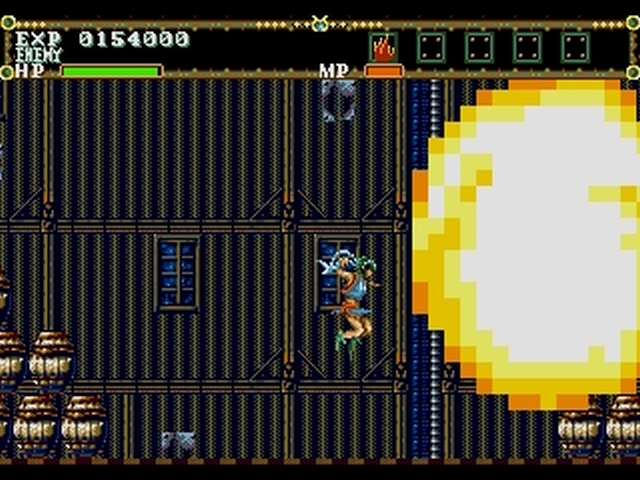
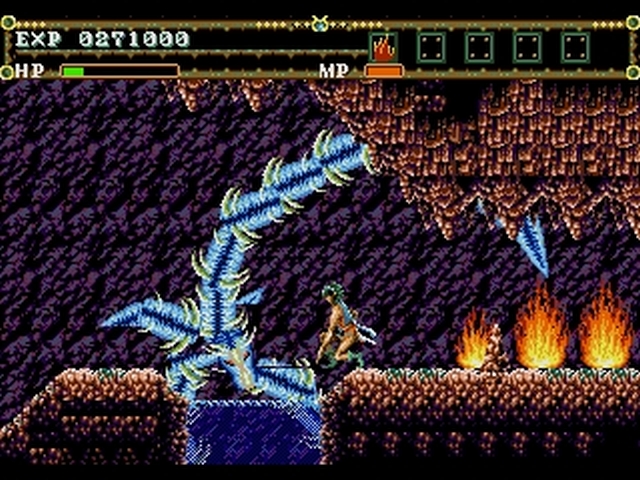
Upon starting the game, the player is instantly assaulted with a sludge of brown and grey pixels in a city level. With worse tech than the underwhelming Earnest Evans, we're left with backdrops and tilesets that are bland at best and eye-straining at worst. To a degree, this also applies to the sprite work; Annet herself has fluid and communicative animations imbued with personality, but far more noticeable is the screen being regularly obscured by the worst explosions I've seen in a game. Other examples of the sheer ineptitude on display here include hideous up-scaled enemy sprites and Level 3's initiation of making it difficult to determine background details with foreground props. Of course, the art direction is as incoherent as one can expect from the makers of Earnest Evans. On a visual front, this game is no Mega Turrican -- or even a Strider, to use a more contemporary example.
Sonically, El Viento doesn't fare much better. Aside from 8-bit garbageware and bootlegs, the sound effects of this game are some of the worst of the era. As Super Castlevania IV was reinterpreting sounds in new, hard-hitting fashions, El Viento demonstrated all the melodic grace of a baby blowing raspberries. From those abominable explosions to the mere act of crumbling blocks, the awful sound design fails to represent onscreen actions and creates a constant disconnect as a result of its flatulent discordance. The soundtrack by Motoi Sakuraba fares far better but is hard to appreciate during all the "BWAEH BWAEH BWAEH" going on.
The audio-visual design hurts the gameplay, though the controls are likely the strongest part of the game. Annet's movements are simple and easily controllable, and she is blessed with reliable ranged attacks, as well. These are rare commodities of the era, and Wolfteam should be credited for this; still, El Viento is strange in what it has and what it lacks in terms of quality-of-life features.
Annet has a dash, but you have to press down, the desired horizontal direction, and (mash) jump simultaneously, which is as hard to execute when needed as it is easy to perform by accident. A generous health bar is quickly drained by the absence of invincibility frames and is accompanied by a meager number of continues instead of any lives or checkpoints; die thrice, start everything over. Multiple special ranged attacks use a quickly refilling meter (no Mega Man ammo nonsense), but the game neglects the shoulder buttons entirely in favor of an easily botched system demanding that the player hold the special attack button (but not too long) in order to select a different move. Oh, and using special attacks cancels out the projectiles you've already fired. All good design is met with poor design, and this applies to the levels, too.
 Credit: Wolf Team/Renovation Products/Telenet
 Credit: Wolf Team/Renovation Products/Telenet
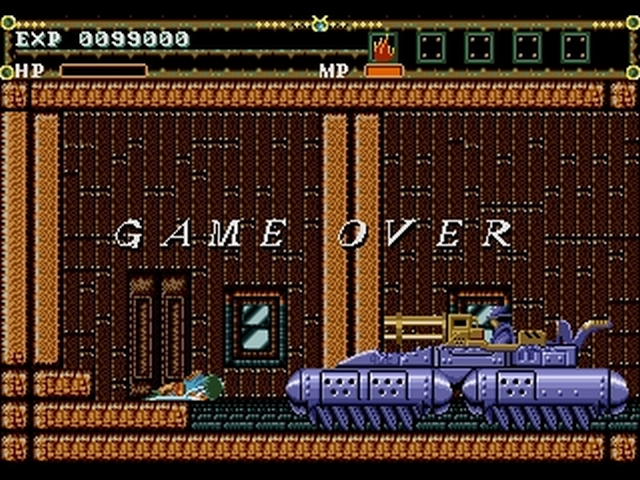
Unique aesthetic or not, the first level is a desert of creativity, not only in its color palette but in its layout. It features such challenges as having to run along a flat expanse while mashing the attack button toward clown cars of enemies, dodging falling garbage, and squeezing through linear interiors that appear to be designed for a sprite smaller than Annet's. After this tedium, the game slaps you with a three-phase tank boss that gives Annet the spatial equivalent of three adjacent gym lockers as she is bombarded by fast-moving shells. The first phase seems to be arbitrary death, but the tank has a tell for its attacks... located at the side of the busy screen opposite Annet. The second phase might as well be arbitrary death, as projectiles are lobbed at strange angles, shielding the tank from your attacks and blocking the screen with those bad romhack-tier explosions when hit. And then the third phase can be cheesed by crouching. Oh, and if you die, you start the whole level over.
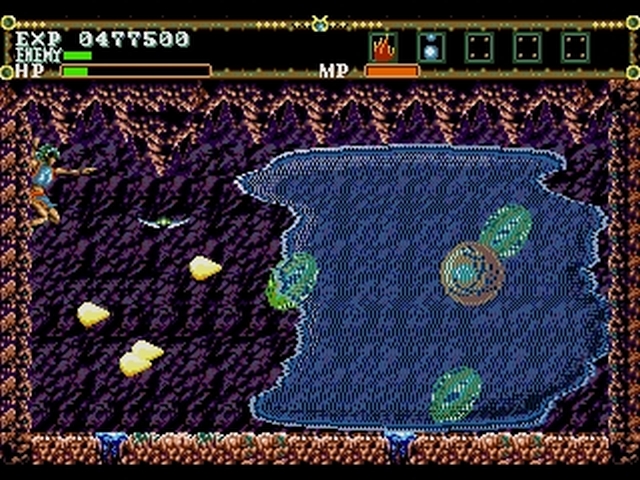
The following levels are varied but demonstrate the careful attention to flow and consistency as a Mad Libs story. In level two, Mount Rushmore seems to have been invaded by alien plants. Its level design is rather forgiving when it comes to pits, but things worsen in stage three. After fighting some dragons at glorious 7 FPS, -- did I mention how awful the performance can get? -- Annet gets a bubble spell that she must use five times to get past some flames as you're yet again challenged to do the same thing over and over. Not 30 seconds later, you fight an even less fun Yellow Devil that the bubble spell is difficult to use against. What in the world?
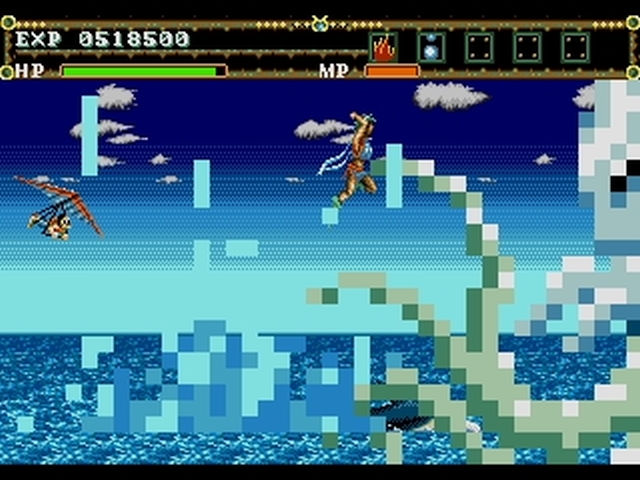
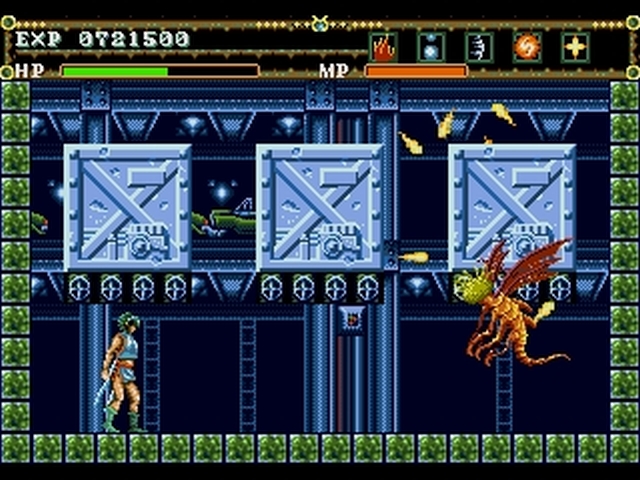
Level four starts with even more nonsense, as you ride a dolphin and shake your head in disbelief as the screen fills with hideous splash effects and enemy sprites. Inside a ship are puzzles revolving around Annet's imprecise dash; it's actually a great change of pace since the spikes don't insta-kill you, and the level's requirement of dash-mastery prepares you for the next boss's only attack. This passing resemblance of good design is followed by vomit-tinted Graveminds and hallways of the same annoying flying enemy in level five. At least you get a spell that covers the screen in yet more ugly explosions. After meeting some familiar faces from Earnest Evans and defeating a "watch the shifting cups" "boss," Annet is hurled into more nonsense on an airship stage with projectiles everywhere. Arbitrary bullet hell = challenge = good game design, in Wolf Team's book. After another slog and boss with no tell for its attacks, Annet must go to the Empire State Building, which is inexplicably actually a demonic totem. I'm sure I could call structures of other nations monuments of evil without being decried as a racist!
 Credit: Wolf Team/Renovation Products/Telenet
 Credit: Wolf Team/Renovation Products/Telenet
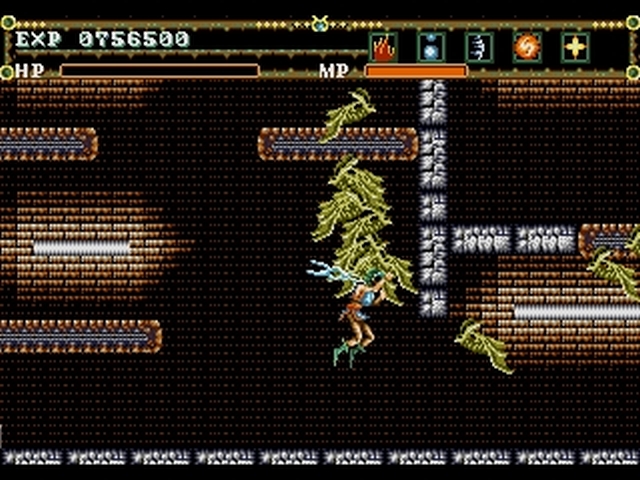
I was hoping to credit El Viento for its variety and personality, but the final level erased my good will. Like mazes with dead ends? Switches? Elevator puzzles? Being swarmed by dozens of speedy, puke-yellow bats? How 'bout all that and more? It's questionable to introduce new mechanics in the final level, and getting Zerg-rushed as I tried to solve puzzles was aggressively aggravating. The final boss is at least as bad, a snake-thing that flails around like an idiot and swarms the screen with homing projectiles. If you die, start the whole level over! Die thrice, start the whole game over! Game design!
As Annet wept for the price she had to pay to save humanity, I felt a bit sad, too. Not because the plot moved me, but because Wolf Team seemed to try to. They tried to make a good game yet fell short; but why should I care for their effort if better works have at least as much put into them? I'd like to play a good Wolf Team game -- I'd instantly give the promising Arcus 1-2-3 a shot if it was in English -- but this wasn't it. For every good aspect of El Viento, a selection of problems arises to thwart it. Annet's movement and animations are fluid, but the game hurts the eyes elsewhere. The music is great, but the sound design is terrible. You've a selection of readily available special attacks, but the UI is so bad that you'll be using the wrong ones and cancelling your own attacks by accident. The cutscenes help pacing, but the paint-by-numbers plot means even less if you can't deal with the bad level and boss design along the way. El Viento has some high points, but the low ones are too low and too plentiful. Like the game for its zaniness or dislike it for his plethora of flaws, it's best to let El Viento and its ill-conceived ilk stay in the past, and let the more ingenious likes of Dust, Hollow Knight, and Environmental Station Alpha lead the second dimension into a brighter future.
 Credit: Wolf Team/Renovation Products/Telenet