
The best moments in Perception are unscripted and accidental, but they absolutely work in service to the game’s big hook. Cassie, the protagonist, is blind. Even so, she has chosen to pick her way through an abandoned mansion that repeatedly crops up in her dreams. Rather than fumble around in a blank screen, she learns to navigate by way of echolocation (using sound distortion to provide little fleeting pictures of her surroundings, mapped out by volume sources). She’s somewhat aided by the environment, which offers up cues like swirling wind or dripping water, but her main asset is her cane. She can tap it to gain a ripple of temporary sight.
The little waves of vision her cane provides render the most innocent of household objects momentarily sinister. A snatched glimpse at some furniture from the wrong angle briefly gives the impression that someone is waiting silently in the darkness for you. Billowing curtains alert you to ethereal movement that didn’t exist until a few seconds ago, and vanish from view just as quickly as they appeared. When you're put in an uneasy state of mind and that existence is coupled with the uniquely limited visibility of the exploration, it becomes remarkably easy to spook Cassie and, therefore, yourself. So it’s a shame Perception rarely ever manages to put you purposefully on edge.
 Credit: The Deep End Games/Feardemic
It’s not for want of trying; Cassie’s tale is a ghost story that finds her exploring the mansion in order to discover the grisly fates of the occupants that once dwelled there. Over the course of four chapters, the mansion itself becomes the game’s real antagonist, warping its hallways at will in order to shepherd Cassie from one macabre discovery to the next. Each chapter shifts back in time, depicting first the most recent tenants and traveling back from there to periods such as the World War or early pilgrimage America. But all you’re ever really asked to do is wander around the vast, empty house reading scattered notes that hint at your period’s backstory, solving very rudimentary puzzles and unlocking doors along the way.
It would be a little unfair (but also not entirely inaccurate) to call Perception a "walking simulator" that also happens to feature a good vision gimmick. The chapters are all wrapped up by visiting one location or another, receiving a prompt to travel elsewhere, and then stumbling your way over there to repeat the cycle. The game’s most obvious attempt at horror comes in the form of The Presence, an invincible entity that wanders the mansion and is attracted by noise. This should prove an underpinning dynamic, considering your best means of traversing the mansion is to make a racket and then follow the resulting echoes. You need that noise to progress, but it could also summon a muttering homicidal ghost at any moment. Except, aside from some admittedly good set pieces, I rarely saw the little blighter.
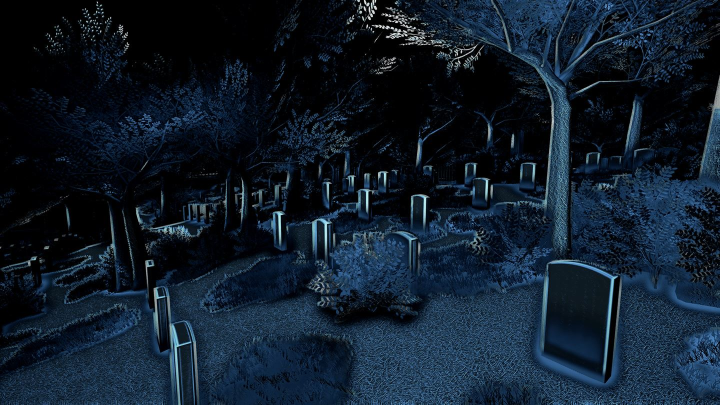 Credit: The Deep End Games/Feardemic
The mansion is littered with chests and cupboards to hide in, providing little holes to peek out of so you can tremble at the sight of your otherworldly stalker as he lurches past. It’s a feature I had to use exactly once in the entire game, however. When The Presence has a pre-scripted scare to dole out, it’s often quite strong, but his use as a wandering fear mechanic is sporadic at best and just plain irritating at worst. The few times I did bump into him, I safely survived the encounter by crouching in a corner for a few seconds and sneaking out the door he’d just entered. Whenever that wasn’t an option, I just ran away. Considering she’s blind, Cassie sure can run.
Banged shins DLC available now Aside from flawless sprints, Perception’s biggest boon is how hard it commits to overcoming Cassie’s blindness. The echolocation vision can only get her so far, so she’s pre-armed with a smartphone filled with apps that translate written text to robo-speak, or send photos she’s taken to one of those smug buggers with working eyes who can describe things for her. One of the game’s highlights for me was listening to her online helper get consistently more freaked out at the images being sent to his mobile and wondering at what point he should call the police to rescue the blind girl who is stuck in a hellhouse. That’s a point he never quite reaches, though, instead leaving Cassie to run through the house’s mysteries in about three or so hours.
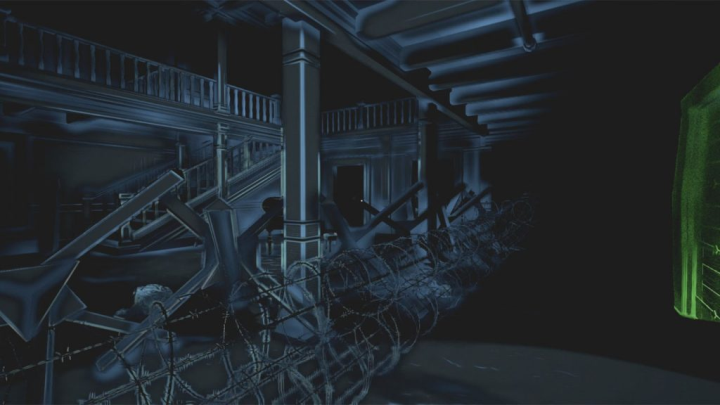 Credit: The Deep End Games/Feardemic
It’s not a long game, but the shallow scares, plodding explorations and meandering tales conspire to ensure that the short run time feels like a boon. I was definitely ready for the game’s rushed conclusion by the time it arrived, which, for a tale lasting only a handful of hours, isn’t a laudable place to be.
Perception’s a shoddily-executed good idea, a concept that should work in theory but which really needed a better experience built around it to reach its full potential. That the best moments the game could offer were accidental snippets of sudden horror that were manufactured in the confines of my own mind is directly related to the fact that the developers' idea of a scare is to creak a door open for the umpteenth time, or knock another vase off a table you probably can’t see. It’s an interesting idea that sadly manifests as only a middling video game.