What I love about video games is how someone can come up with a goofy or abstract idea, and the majority of gamers won't even gawk at the concept. A plumber fighting a turtle over a kingdom of sentient mushrooms? One of the most beloved games of all time. So, it shouldn't come as a surprise the same company that brought us such a silly premise would unashamedly release a game where players need to duel with the aid of balloons. That's it; no guns, weird fire plant powers, or fisticuffs to be had here, just a pair of balloons attached to your protagonist and the ability to float about by flapping his hands.
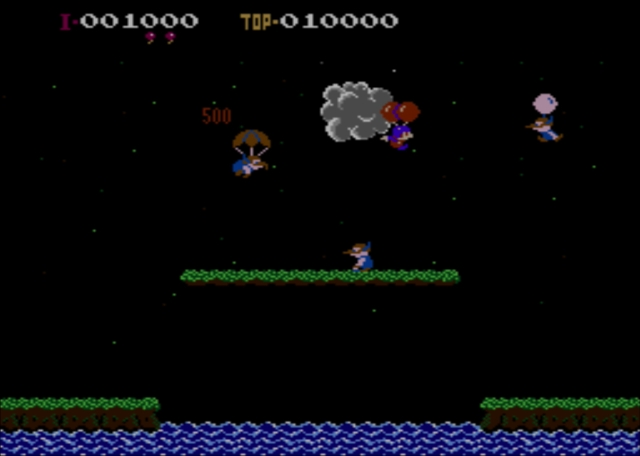
Though, as uncomplicated as that sounds, once you play a bit of Balloon Fight's Mode A, things can easily spiral into a daunting trial. The goal is to clear each screen of rivals sporting balloons, donning borderline-creepy bird masks, and this is done by bumping into one while being higher than they are, then once more to remove them from the screen. Challenges come in several forms, first and foremost being the presence of numerous enemies bouncing around the level's looped single screen, all which can easily pop your balloons if you carelessly allow them. Tread too close to the water below, and get swallowed whole by a giant fish, or if you overstay your welcome in certain stages, lightning orbs manifest from clouds, casually ricocheting around the screen and killing in one hit.
 Credit: Nintendo
 Credit: Nintendo
If this style of play sounds a tad familiar, it's because Mode A's basis is lifted from 1982's Joust. It's not an exact replica, though, as Mode A makes a couple changes to differentiate from its source. 1986's Balloon Fight has a new rogues gallery, that much is obvious, but the other main difference is how its level design completely changes from stage to stage. This is actually a very interesting observation, because if you've played Joust even for just a few rounds, you'll notice its layouts allow for a horizontal advantage; platforms give players the opportunity to sprint from one side of the screen to the other, thus jousting opponents when done right.
However, Mode A does a combination of lengthy platforms and tiny pieces strewn about, which, in certain stages, serve as speed bumps and obstacles, causing a resistance to any simple strategies you had going. Add the rogues gallery to the equation, not to mention a second player if you're doing Mode B, and it becomes a bit tense. Instead of being able to spring from one side to the other without much of a hassle, you're instead forced to use the intentionally floaty controls skillfully, carefully navigating around stuff, in order to survive. It's a nice "twist" to the original formula, even if it's just a meager modification.
So what if you're currently not in the mood for some Joust-style action? You can then switch over to Mode C, also known as Balloon Trip. Here, you need to guide your protagonist across the seas in an endless auto-scrolling level, and must do so while popping balloons that drop your rank from 47 to one. Greeting you on this never-ending journey is an onslaught of lightning orbs of various structures and patterns; it starts off easy with a brief encounter against stationary orbs, but quickly transition into numerous, moving orbs, going to and fro in a vertical fashion. And, well, it eventually succumbs to you dodging orbs moving around haphazardly. Basically... catch a bunch of balloons in a one-hit kill maze. Good luck!
 Credit: Nintendo
Despite emoting an idea so basic and straightforward, Mode C can quickly become amusing to players embracing its simple concept. That's because Balloon Trip adheres to the "simple to play, hard to master" process, something that, if done right, can entice people to keep coming back because there's no extra baggage to wade through; it's "pick up and play" in its purist form. In one playthrough, you might be having the best streak ever, only to lose due to fatigue, the next could have you dying instantly because you got cocky, and several playthroughs later can have you nearing rank one again, only to die because you were too close to the water and forgot there was something lurking beneath. The formula is sound, which is why it continues to succeed decades later as seen in similarly-themed games like Geometry Dash and Flappy Bird.
Balloon Fight definitely won't be to everyone's liking, since I'm sure some people would rather play a more "traditional" game with more variety and length in the same vein as Super Mario Brothers. Also, you kinda need to be in the right mood to play, as its leisure pacing and one swift death at the start of Mode C can quickly compel a quit if you're really not feeling it. Still, Balloon Fight is commendable for being a very simplistic time-waster with lasting entertainment and replay value, which is a hard thing to pull off.