 Credit: From Software/SCEA/SCEI
With every game of his that releases, it becomes increasingly remarkable what Hidetaka Miyazaki and his team at From Software have accomplished with the Souls series. These titles really do constitute their own subgenre; the heavy combat, winding level design and minimalist storytelling methods are unmistakable even when the setting has shifted and the word "souls" isn't in the title anymore.
In fact, seeing this familiar formula applied to the world of an entirely new IP is part of what makes Bloodborne so fantastic. While I liked last year's Dark Souls II, I felt that From Software was showing signs of spreading the dark fantasy theme a bit thin, with too many ideas rehashed from previous titles and most of the bosses equating to uneventful battles against "big dudes in armor." No longer bound by franchise, Miyazaki has taken his blueprint to the streets of a Gothic city succumbing to lunacy (in the very literal sense of being driven mad by changes in the moon) and Lovecraftian horrors. It's both thematically and mechanically different enough to feel fresh while still providing us Souls fans with precisely the experience we're looking for. It's an extraordinary piece of work.
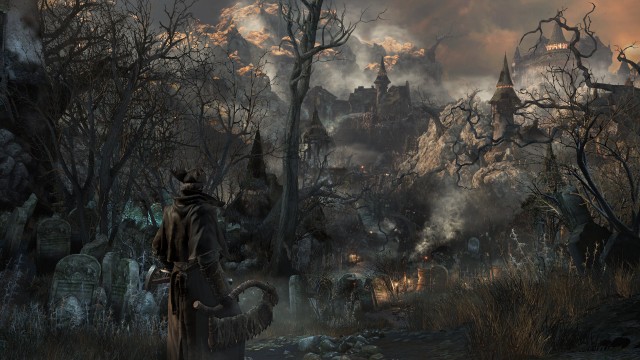
Bloodborne's gameplay has largely been defined by its lack of shields, but that's only one component in a much broader shift in focus. Ranged weapons are now merely supplementary and magic is largely restricted to expandable items that most people won't even bother with. There's no more turtling, no more cheesing, and very little caution. Bloodborne is about aggression. Most of your attacks will be melee-based, and your only primary defenses are swift footwork and well-timed counters. Shields have been replaced with sidearms, which can be used to interrupt enemy attacks; it's a lot like the Souls parry, except that it's not as easy to ignore this time since your defensive options are fewer. While I disagree with the numerous comparisons being made to Devil May Cry, it's undeniable that Bloodborne's combat is considerably faster and more immediate than that of its predecessors.
 Credit: From Software/SCEA/SCEI
The Souls games are famously unwelcoming, and there's been question over the years as to whether From Software would be taking steps to make their games more accessible to those who found the barrier to entry too solid. If anything, though, Bloodborne is their most impenetrable release of this run because it's so deliberately inflexible. The Souls games offered numerous play styles, whereas Bloodborne punishes you for not adapting. While some adjustments have been made to accommodate this shift in focus – hit boxes are now more generous so it's feasible to avoid taking damage while you're close to an enemy – your opposition is no less aggressive here than they were in previous entries. They could not care less that you don't have a shield to hide behind this time.
Of course, the controls, interface, and even font will be instantly recognizable to most, and a couple of handicaps have been added to balance the scales a bit. There's now a risk-and-reward system for regaining health on the fly. When you take a hit, there's a very brief window in which you can gain that HP back by landing a few strikes of your own, which forces players to break their instinct of rolling the hell away and recovering when they've sustained damage. Healing items are also more plentiful, and there's less penalty for death this time, beyond the obvious loss of experience and progress. Previous Souls games condemned risk-takers to weaker states, but in Bloodborne, there's actual merit in repeatedly launching yourself into a wall in the hopes that it'll eventually crumble. As From Software taketh, so do they giveth back.
Still, while the emphasis on quick-footedness may attract players who found Miyazaki's previous work too slow for their liking, newcomers looking for a good entry point probably shouldn't start here. Bloodborne is made for Souls vets looking for something new to master. As someone who played through both Dark Souls and its sequel three times apiece last year, Bloodborne's combat was an overwhelming adjustment for me, yet, as always, the struggle was worth it. In true form, the game sticks to its "rules" adamantly, and I progressed at a much quicker pace once I'd settled into a groove and was easily able to gauge what I'd been doing wrong and how to avoid that on subsequent attempts. In other words, it was like discovering Dark Souls all over again.
 Credit: From Software/SCEA/SCEI
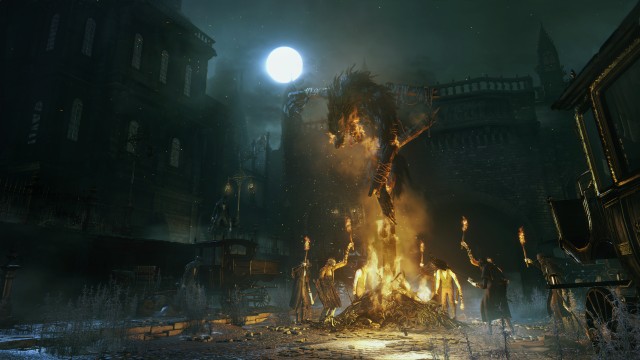
That sense of reward also expectedly carries over into Bloodborne's story and world design, told in Miyazaki's usual cryptic, minimalistic style. The Souls games are built like Metroidvanias, and they use that element of exploration to show rather than tell, as we're only given the barest outline of a plot and are left to sort out the whos and whats of the setting on our own. It's so foggy that there's always a sort of community effort to piece it all together whenever one of these games releases. As I write this, Bloodborne has been in public hands for less than a week, and it'll be a while before all of its mysteries are solved.
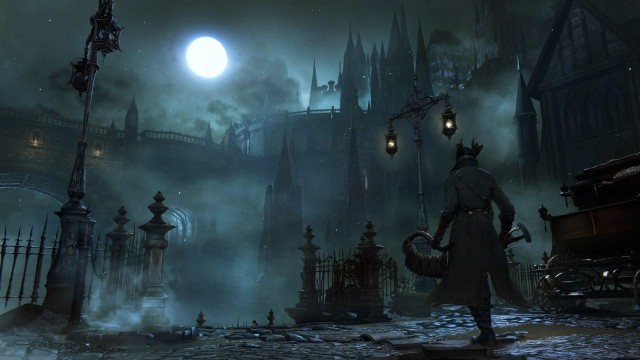
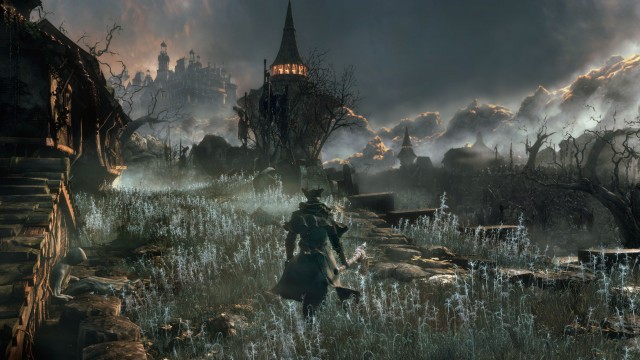
The gist is that our character seeks a remedy for a particular illness in the Gothic city of Yharnam, where an endemic disease is slowly transforming its inhabitants into beasts. I haven't seen the word "lycanthropy" specifically dropped in Bloodborne, but that's the insinuation, as the monsters are typically hairy and werewolf-like, and the moon itself has an inescapable presence over the city. Yharnam itself is a marvel to behold; while it's not exactly vibrant, it's sprawling and intimidating in ways we've come to expect of the worlds that From Software builds for us, with massive spires protruding from every direction and entrapping us like fingers reaching from the bowels of hell.
I can't really overstate how well an uncompromising horror theme blends with this formula of game design. The Souls games have always been rattling; the creature designs are imaginatively fiendish and the knowledge that anything can handily kill you makes players scared just to turn corners. Pairing it with actual Gothic influences makes me realize just how much Souls has in common with traditional survival horror, from item conservation to atmosphere, and it results in one of the scariest games I've ever played. Also, remember how From Software had to neuter Dark Souls II's lighting effects just to get the game stable on last-gen consoles? That's not the case here. Yharnam is shrouded in darkness, and for once, players have a valid incentive to be carrying a torch with them, especially since the main character's left hand is no longer glued to a shield.
 Credit: From Software/SCEA/SCEI
Miyazaki's previous work took us to worlds that were on their last breath. While Yharnam certainly feels doomed, Bloodborne pulls us back a bit earlier in that process, and we see this city in the early hours of its downfall. The game is uncharacteristically full of speaking roles, but most friendly voices are behind locked doors, while many other voices are, uh, not friendly at all. (It's discomfiting to hear enemies in a Souls game actually speak to you.) The game gets less wordy as it channels Lovecraft full-on in its bizarre, nightmarish second half; as the imagery gets more unsettling and events become harder to comprehend, it's difficult not to liken Bloodborne to a descent into madness.
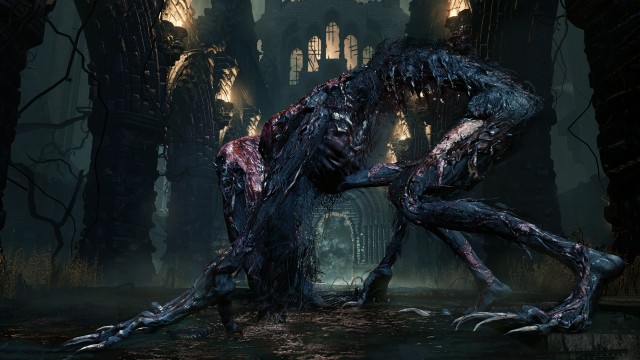
In fact, I know that the word "Lovecraftian" gets thrown around a bit too much, but it applies here, and not just because bits of Bloodborne could be classified as cosmic horror (though there is a blink-and-you'll-miss-it suggestion that some of the game's creepier foes are not of this world). From Software has introduced an ingenious new mechanic called "insight" that doubles as a storytelling device. Insight is gained by completing events or consuming certain items, and it's used to trigger the co-op, if that's your thing. More importantly, insight equates to world awareness. While I won't spoil the specifics, let's just say that a higher insight will give you a better look at the more sinister workings of Yharnam, and some of it is information that you may have wanted to stay ignorant to.
So while insight has advantages, it also burdens your character with an existential weight that holds a very tangible threat. High insight means that you're more susceptible to a new status ailment called "frenzy," which you gain when dealing with Bloodborne's more otherworldly creatures. If your frenzy rating maxes out, you explode. Seriously. Your guts just start pouring out of you. It's a brilliant interactive take on staring into the abyss. The more in tune you are with the horrors around you, the more likely you are to just spontaneously pop under the weight of madness.
 Credit: From Software/SCEA/SCEI
So Bloodborne's got the combat and the atmosphere to rank among From Software's greatest work, though it admittedly has a few issues that prevent it from being a Souls fan's genuine dream game. For one thing, while these folks have always been innovators, they're not exactly technical wizards, as evidenced by the frequent framerate dips and atrocious load times. In a game where you'll be dying so much, spending 30-40 seconds staring at a black screen before each reload is punishing in ways that the team didn't intend. This is exacerbated by the fact that you can't teleport directly between checkpoints – you've got to transit back to the hub and then pick your destination, which is needlessly clunky.
Beyond that, I will say that while Bloodborne's dark, drab color palette is both deliberate and consistent, it can get a bit wearying for such an absorbing game. Bloodborne is shorter than its predecessors (it took me about 27 hours to see everything) and it's probably for the best, as the art style likely would have worn on me had it taken any longer. This is also a relatively linear adventure in comparison to the Souls series; while there's a lot of clever networking in each individual level, it's straightforward in structure, as there's typically one very specific thing you're intended to be doing at any given time. This, combined with the inflexible combat, amounts to a game that's not quite as open to replay as its brethren (though there is some lasting appeal in the Chalice Dungeon, a randomly-generated gauntlet with its own unique set of bosses).
Given how much of Bloodborne goes over a single person's head, it'll probably be months before we can definitively say whether this game matches its predecessors in depth. But having spent nearly every free hour of the last four or five days playing Bloodborne, I can safely say that few minds in the gaming industry have the power to enrapture me the way Miyazaki does. As someone who once hated his work, I now feel genuinely sorry for those who can't warm over to his punishing but rewarding stew of atmosphere, brutality, curiosity and wonder. I wish we were getting a new game from this guy every month.
P.S. I did actually find one shield, but it blows.