 Credit: HAL Laboratory/Nintendo
It's weird to say it now, but there was a time when touch screen gaming was uncharted territory. Of course, nowadays, it carries the stigma of casual markets, something to be relegated to smartphones while us big kids play with buttons and analog sticks, but there was a brief window between these two eras, and that window birthed the wonderful Kirby: Canvas Curse. The game fearlessly demonstrated how a stylus-based input method could be applied to hardcore gaming in a manner that didn't feel like a gimmick, and it resulted in an experience that couldn't be replicated on more traditional hardware. That was groundbreaking at the time. In a just world, Canvas Curse would be held on nearly as high a pedestal as something like Super Mario 64.
This wasn't even the franchise's first time being ahead of the trends, lest we forget 2001's Kirby Tilt 'n' Tumble doing gyroscope-based controls before they were something to be taken for granted, as well. So why no love for Kirby? I have no idea, but it's nice to get the follow-up that the original deserved, regardless. Kirby and the Rainbow Curse arrives well after touch screen gaming has become an institution, and it feels nowhere near as revelatory now, but it demonstrates that the original formula wasn't a mere novelty. This is sincerely clever, time-tested stuff that any platformer fan should enjoy.
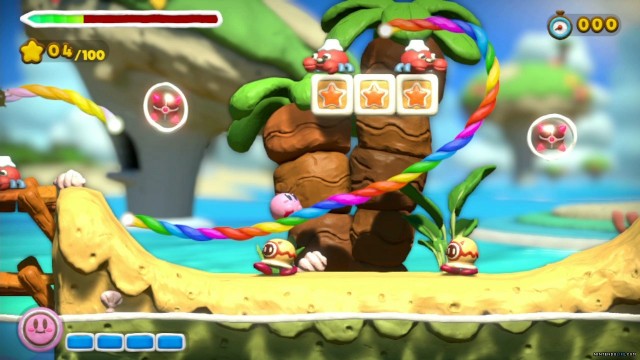
The concept, once again, is that players have no direct control over Kirby. As he rolls around levels like a ball, you direct him about using lines drawn on the Wii U's GamePad. It's usually impossible to bring Kirby to a stop altogether; the most you can do is slow him down, redirect him, or erect walls in his path. Navigating levels, then, is a trickier and more frantic affair than it is in your usual platformer, as there's concern not just about where Kirby is now, but where he'll be in a second or two. In Canvas Curse, our hero was rolling about because he'd lost his limbs. Here, his arms and legs are intact, and he's tucking and rolling because that's just how he chooses to get around, I guess. This makes the concept considerably more arbitrary but also considerably more adorable, so it's a trade-off.
 Credit: HAL Laboratory/Nintendo
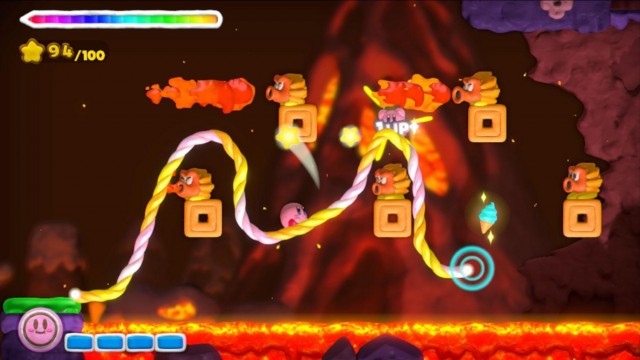
A word on Rainbow Curse's cuteness, by the way. Kirby's previous console outing saw him and his world stitched together with yarn. This time it's polymer clay, looking all squishy and moldable in some of the most vivid 2D art I've yet seen in a video game (supplemented by 3D effects so subtle you'll barely even noticed them). Kirby and his friends are even animated in such a way that emulates stop motion, meaning that the already overwhelming charm of the series is given a further boost by resembling an Aardman production. It's too much, in the best possible way.
That's all beside the point in a game as mechanically inventive as this, though. And yes, guiding a rolling Kirby about using drawn lines (here manifesting as ropes) was already done in Canvas Curse, but the moment-to-moment application of this ability is so rapid-fire that entering a new level always had me excited to see the game's next Big Idea. You've got a limited supply of paint that only heartily recharges when Kirby is on the ground, so keeping him afloat for lengthy periods is often a complicated juggling act. Well-worn platformer tropes – the volcanic shaft slowly filling with lava, the cloud-based level scrolling at a fixed speed – feel fresh when viewed through the Curse lens. My favorite examples are still the underwater levels, which most platformers employ to exhibit one-off distorted physics, but which HAL Laboratory is more devious with. Since Kirby is a puffball, he floats upward when submerged. So the underwater levels play identically to everything else, except that the controls have been flipped in a logical manner. It's such a clever take on what would usually be an eye-rolling cliché.
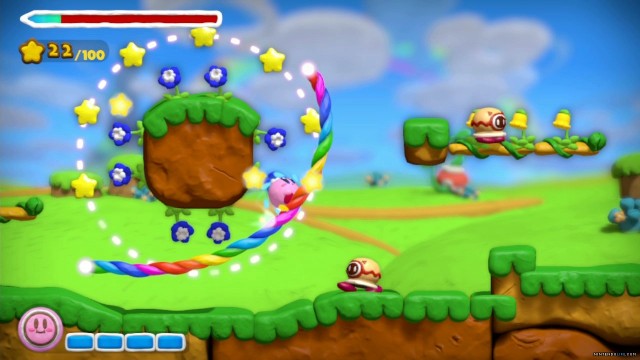
Rainbow Curse often capitalizes on the deliberate unwieldiness of its control scheme – everyone who plays this will, at some point, sabotage their own attempt to pull Kirby away from a hazard by accidentally steering him into a wall that they themselves drew moments ago and hasn't disappeared yet. The game requires a sharp adjustment (or readjustment), but the physics are strong and predictable; Rainbow Curse always follows its own rules, and while the challenge slope grows steep quickly, I never felt cheated. The variety helps, and even the vehicle segments, which should have been gimmicky, feel mechanically in line with everything else, the difference being that you're using lines to direct a tank or a rocket rather than a ball. There's even some gold mined from the "ropes" having a physical presence, such as when you're connecting tracks while Kirby rides around on a skylift.
 Credit: HAL Laboratory/Nintendo
I also appreciate Rainbow Curse's approach to replayability. If you're the sort of person to rent a game, speed through it and swiftly move on to the next thing, you can reach Rainbow Curse's final boss in around five hours and feel satisfied. If you're looking to wring more value out of the game, though, the optional content is a beast. For one thing, the game's collectibles are a treat to hunt down, many of them either deviously hidden or time-sensitive (such as when you need to launch yourself out of a cannon at precisely the right moment so as to catch a treasure chest that's falling out of the sky). If you pursue high scores, you'll be rewarded with challenge levels that actually outnumber the campaign stages. Nintendo was probably smart not to charge full price for Rainbow Curse, but don't believe for a second that there isn't lasting appeal in this game.
Curiously, despite the subseries' migration to a console, there's no real reason for this to be on Wii U aside from the additional crispness of the visuals (which is admittedly a big plus). Since you've got to be looking at the GamePad in order to draw lines, there's literally no reason to even have your TV turned on unless you're engaging in the game's cute but inconsequential co-op mode, in which other players control Waddle Dees who can carry Kirby around. But that and a couple of repeated bosses are the only missteps in a game that I otherwise have no qualm with. Rainbow Curse may not be as important as its predecessor, but it's every inch as lovely. I hope that you give this one as much attention as you should have given Canvas Curse.