
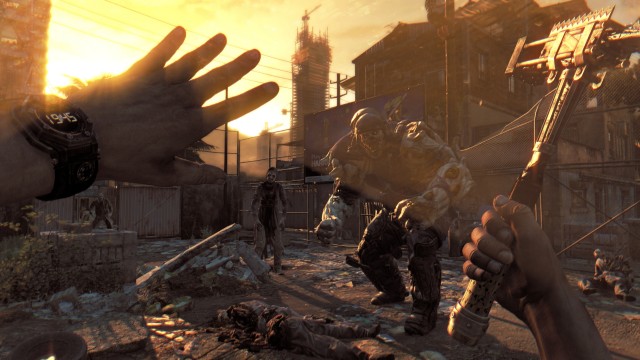
 Credit: Techland/Warner Bros. Interactive
When you spend a great deal of money on a new video card, you do so with the stubborn expectation that every game you play on your PC for the next several years will look gorgeous and run without a hitch. Then you play something like Dying Light. Widespread performance issues scream poor optimization, and no one can consistently nail down the root of the issue, whether it's exclusive to AMD cards, or whether it's an issue relating to view distance, or stemming from the number of cores the game is using, or whatever. Two weeks after release, when the collective nerd minds of the internet can't figure out how to get a game running properly, and when switching from the highest settings to the lowest settings barely has an effect on the awful framerate, it's time to accept that you've released a shoddy product.
So the PC version of Dying Light really wasn't fit for release – after a promisingly smooth opening sequence, we're set loose in the game's sandbox and feel blessed on the occasions when the game can hold 30fps for more than a second or two, or when a melee weapon can be swung without the game freezing up for a split second. This leaves me in the uncomfortable position of having to determine whether Dying Light hosts any value beyond its potentially temporary status as a technical fumble. When I finally threw up my hands in frustration over Dying Light's performance issues, did I do so with the hope of returning one day, discovering that the game had been properly patched, and unearthing its well-guarded entertainment value?
The answer is "no," though it comes with the qualifier that I seem to be a bit more sick of zombies than the rest of the world's population is. I note, however, that two of the best games of the last several years were zombie games: The Last of Us and Telltale's The Walking Dead. You'll note that both of these are heavily narrative-driven titles, because there's dramatic weight in a bleak scenario wherein it's possible to be eaten alive by your dead daughter or whatever. But zombies aren't interesting adversaries, as evidenced by Dying Light's insistence that you just ignore them whenever possible.
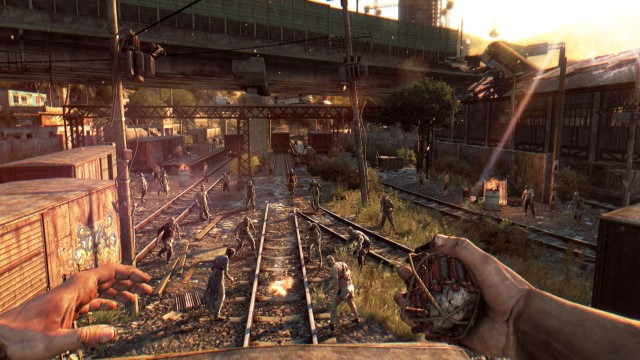 Credit: Techland/Warner Bros. Interactive
Dying Light was developed by Techland, who also made Dead Island. I didn't play that, though I gather that it was considerably more vibrant than this. There are circumstances in which post-apocalyptic cities and drab color palettes go together, but Dying Light commits the cardinal sandbox sin of putting me in a world that I don't want to explore. Since this is a parkour-driven title, you're encouraged to use the environment to stay off the streets and thus avoid being mobbed by zombies, but I managed to do that without much parkour at all. These are largely the slow, middling variety of zombie, and thus it's surprisingly easy to just run right past them until action is awkwardly forced upon you at various points throughout the campaign (at which point the difficulty is directly proportional to how many skills you've unlocked, i.e. how much time you've spent in Dying Light's dull side quests).
For an original IP, Dying Light is shockingly low on ambition. It contains not a single new idea, and almost perfectly fits the model established by Ubisoft, a publisher now famous for design-by-committee. (Dying Light even has you climbing communication towers.) It's a grab bag of clichés. Weapon degradation, one two. Crafting system, three four. There's a lockpicking mechanic that's identical to the one used in Bethesda's games. There's a stamina meter, because that's "in" right now, but it only applies to combat. So our character can sprint indefinitely and scale vertical surfaces with no consequence, but the moment he's called upon to attack, it's three or four swings and he's out.
The platforming is fine, though Techland fails to make it a pivotal component of Dying Light, nor does the design of the city frequently reflect that this is supposed to be a core aspect of the game. One of my favorite releases of last year, Sunset Overdrive, was also a sandbox title set in a zombie-infested city with a major emphasis on staying off the ground, but that game's world design was a wonderland of networked platforming. Here, climbing buildings and navigating rooftops is just kinda something you can do if you want, and it'll usually slow you down, anyway.
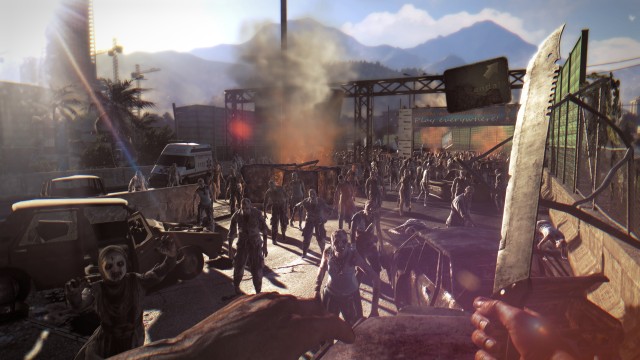 Credit: Techland/Warner Bros. Interactive
I mentioned earlier that zombies can still work as solid storytelling devices, which probably gave away the fact that Dying Light has very little narrative value. The game glosses over the initial outbreak and skips to point when zombies are pretty much an accepted thing. The main character is recruited by a group of survivors who all do that sandbox thing where they sit behind desks, put waypoints on your radar and then tell you that they won't trust you until you go chase some of those waypoints for a while. There's no urgency to a setting like that, and it feels irritatingly arbitrary almost immediately. Plus, these people seem to have plenty of guns, but it rarely seems to cross their minds to lend one of them to the guy they're sending out of the safe zones, particularly when melee weapons break so quickly and our protagonist can't swing any of them more than a handful of times before needing a recharge. (Further evidence that we're controlling the worst soldier in the world: he parachutes into the city, lands, and is incapacitated literally before he takes a single step.)
The writing walks the vast span between perfunctory and trite, the high/low points typically being the narration that fills the load times. When the protagonist (whose name, it will not surprise you to learn, I've forgotten) is sent on an early rescue mission only to discover that the man has turned, he says, "I didn't sign up for this!" What? You were airdropped into a zombie-infested quarantine zone! What did you sign up for, exactly? I appreciate that the game was given a Middle Eastern setting, but it's done a terrible injustice by characters that I'd hesitate to even call "one-note," because that implies that they have any notes to begin with.
None of this makes Dying Light bad – just generic. You know what does make the game bad? All of that, plus the maddening framerate issues that plague it on this particular platform. I don't see much appeal in the core experience of Dying Light to begin with, but that it's so off-puttingly choppy means that even those who find value in this celebration of zombie clichés should probably play it elsewhere or hold off altogether. If this is any indication, skipping Dead Island was probably a good idea.