When I first saw the trailer for Compulsion Games’ Contrast, I was instantly hooked. As a fan of film noir, I thought it looked absolutely stunning and showed a lot of promise. After finally getting my hands on it, though, what I originally pegged as a potential game of the year candidate is now high on my list of the same period’s biggest disappointments.
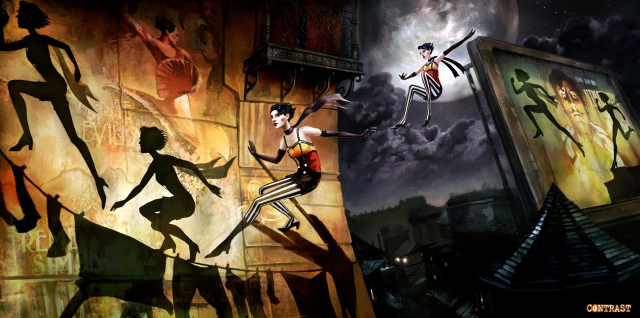
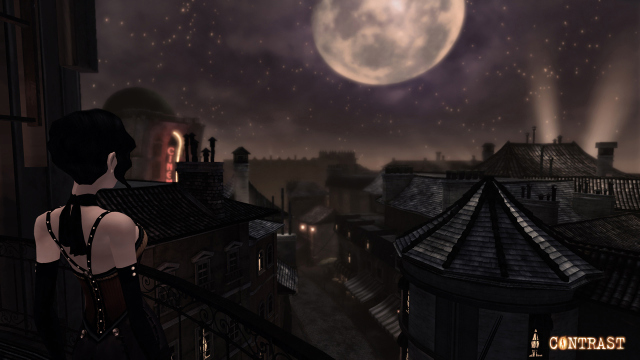
Set in what appears to be 1920s Paris, Contrast is a monochrome, vaudevillian puzzle-platformer filled with stage lights, smoky night clubs, jazz, magicians and carnivals. Parts of the city are broken, with chunks of sidewalk and other debris floating around in the void. It's a very moody and surreal experience, with lovely use of light and shadow that makes the bleak surroundings vibrant.
 Credit: Compulsion Games/Focus Home Interactive
The narrative focuses on 8-year-old Didi and her imaginary, acrobat friend Dawn, whom the player controls. With Dawn's help, Didi aims to get her lounge singin' mother and deadbeat father back together. As naïve as this seems, her willingness to try and get her dad to straighten up and fly right is cute despite also being a tad cliché.
Other than Didi and Dawn, all of the characters exist in the shadow realm and are visible only as silhouettes. They can see and talk with Didi, but naturally none of them can see Dawn. This is not only visually impressive; it's also a unique way to experience a story and fits the tone.
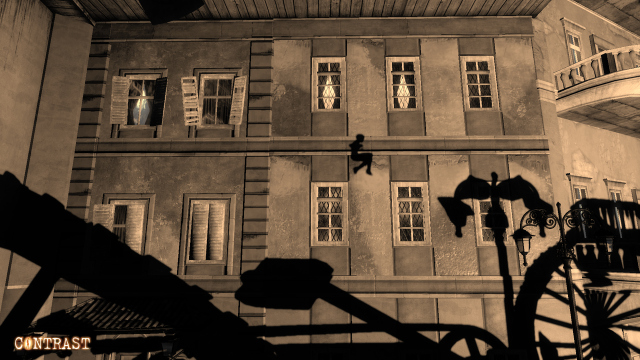
The mechanics consist of an interesting mix of 2D and 3D gameplay. Dawn can shift in and out of the two realms when standing next to walls bathed in light, and in doing so can run and jump on the shadows of the objects in the room. She's also able to alter shadows by moving around spotlights and various items in order to reach new areas and collect orbs called “luminaries” that are used to activate merry-go-rounds, elevators, control panels and other devices.
I was impressed with how intuitively some of the areas are designed. None of the collectibles (notes and newspaper clippings that provide more backstory, to go along with the luminaries) are out of the way, and the game has some clever tricks in respect to the puzzles, including areas that force your character to climb up the large shadows of some of other characters while they're talking.
 Credit: Compulsion Games/Focus Home Interactive
However, there is a lack of flow in the difficulty, since a couple of the earlier puzzles are tougher to solve than some encountered later. None of them are true head-scratchers, though. Most of the time, it's pretty obvious what needs to be moved in a room so the shadows will line up correctly and Dawn can climb. While this is fine to keep the plot moving, one or two obtuse brain-teasers would've been welcome.
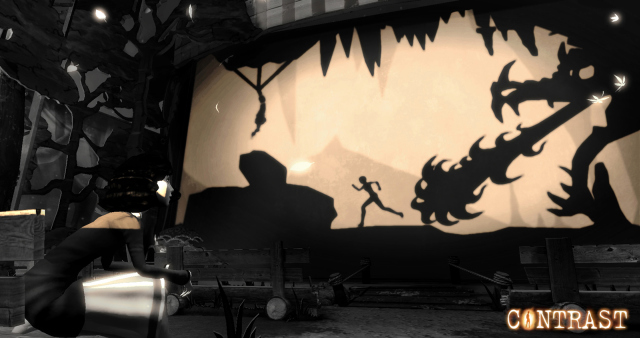
Contrast is at its most inventive at around the adventure’s midpoint, when Dawn and Didi set out to repair the attractions at her dad's carnival. They have to fix a broken down pirate ship and participate in a play, with Dawn taking the lead role as a princess on a quest to save a knight. It's during this shadow puppet theatre where the game is at its most platform-y, with Dawn avoiding obstacles and even taking down a couple of bosses.
Unfortunately, even though it's a nice diversion, the play lasts much too long and some of the jumps are incredibly awkward and frustrating. The silver lining here is that this part isn't nearly buggy as the rest of the game.
The gameplay throughout most of Contrast can be a complete nuisance thanks to some infuriating glitches, including a host of clipping errors that ruin many of the puzzles. To make things worse, the button to “shift” isn't as responsive as it should be, which really doesn't help when players are faced with a puzzle that requires Dawn to switch forms quickly. Moving around boxes to place on buttons that open up doors can be even more of a struggle. For some reason, I kept getting stuck while trying to drag one of them around and would have to jiggle the analog stick to break free.
 Credit: Compulsion Games/Focus Home Interactive
As troublesome as these problems are, my biggest gripe with Contrast is the writing. Despite the French setting, the story has a distinct American pulp feel that at times led me to believe that it might turn into a commentary on broken families, greed or deception. Instead, it opts for a more lighthearted approach, with Didi's father trying to make some fast money in order to pay back the gangsters he owes and ultimately win back his ex-wife. It's a common tale with the sort of dialogue one would expect, including lines like “don't expect to jitterbug back into our lives” and other dated lingo that almost pushes the plot into parody territory.
The developers were attempting to deliver a story shrouded in mystery, but it never really does enough to get where it wants to go. It teases at the idea that there's something deeper going on behind the scenes, but the themes just aren't clear. The final act does hint at a big reveal of sorts, but instead of following through, it ends abruptly in a “That was it?” fashion. Perhaps if the game was longer and contained more foreshadowing, the sudden roll of the credits wouldn't prove so jarring.
Contrast gives the impression that it has something to say. Instead, it fumbles the words. It's a fantastic concept with brilliant visuals, nice set pieces and decent mechanics, but the puzzles rarely get difficult and are plagued with bugs, plus the writing frames everything in a heavy-handed manner. There might be a good game underneath all of the mess, but it would take a lot more polish to enable this lackluster affair to sparkle.