It was how those doors reluctantly creaked open and then slammed shut behind you. How Jill’s feet gently pattered across the soft carpet then clunked loudly off the solid marble floor. How those crows cawed madly and you could make out blood curdling howls from somewhere way off in the distance. The Spencer residence was so deathly quiet that every little sound – abnormal or otherwise – was disconcerting. Even the methodical ticking of a grandfather clock somehow consumed you with dread. Resident Evil expertly captured that feeling of solitude. Trapped in the backend of nowhere with the sound of your own footsteps and the creaks and groans of a mysterious mansion for company.
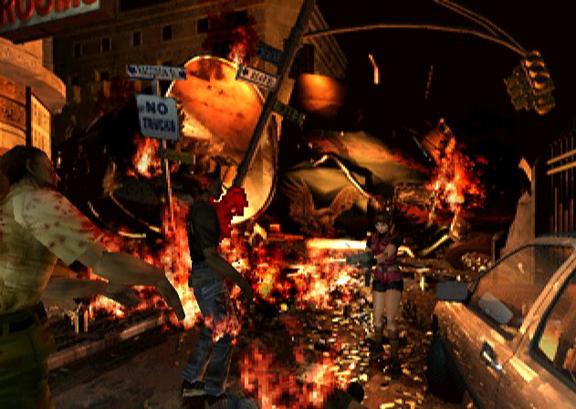
From the outset the sequel tones down the eeriness and goes all out apocalyptic. Vast packs of zombies lurch around on fire, their moans far louder and more agonized than before. Flames whip through burning cars littering the streets, roads are fortified with barricades and graffiti coated shop fronts boarded up. This once sedate town looks like an urban warzone. Resident Evil 2’s memorable opening captures the scale of the viral outbreak within seconds. This isn't an isolated incident in a creepy old house on some faraway hill: it’s an epidemic.
 Credit: Capcom
This is the reality that faces rookie cop Leon Kennedy and Claire Redfield when they arrive in Raccoon City. After Leon’s first day on the job goes from bad to worse, a chance encounter with Claire leads to the pair fleeing for their lives from a careering oil tanker. In typically melodramatic Resi fashion the two are “parted by an unescapable destiny”, and are forced to fight their separate ways through the undead streets to the police station.
Inevitably this is not the sanctuary that either had hoped for, with little evidence of rule or order. The Umbrella Corporation has a firm grip on the hierarchy of Raccoon City’s law enforcement, manipulating authority in the interest of its own sordid motives. It’s a conspiracy that has far more serious implications for Leon and Claire beyond the bloodthirsty monsters stalking the RPD’s hallways and city streets beyond.
The original game’s ‘haunted’ house was in line with more traditional ghost story themes. Resident Evil 2, however, sources a much wider range of horror influences.
Of course the most obvious is the Romero inspired zombie apocalypse – a once cult theme that developed into a pop culture phenomenon. There’s William Birkin, the power crazed scientist quite literally consumed by his own research. Mr X’s relentless pursuit through the RPD could have been ripped from the reel of all manner of slasher flicks. It’s got hideous host invading parasites, creatures bursting from chests, mutant plant life and self destructing laboratories. How about an alligator the size of a double decker bus? Scripting and voice acting is of unashamed B-movie quality, gleefully played out against a backdrop of “explicit violence and gore”. Resident Evil 2 brilliantly walks the line between schlock and serious horror.
The action dial has undoubtedly been cranked up a notch but the sequel still maintains a certain degree of crypticness. The Spencer Mansion stubbornly concealed its secrets behind riddles, puzzles and coded doors. Although the police station isn't quite as unforthcoming, it still won’t grant Leon and Claire ready access. The only way to grab an important early key, for example, is to insert a mysterious unicorn-crested medal into a mechanised stone statue. Hidden jewels, obscure plugs, stone tablets and the trusty crank must all be found and employed to progress. It’s weird for an upstanding community police department to be so damn secretive.
But the more you learn about the paranoid and volatile Chief Irons, the more this starts to make sense. Irons is a man with more than few skeletons in the closet. He’s desperate to protect his underhand interests at any cost. As a result, the trail that snakes behind him through the RPD and down into the sewers has become increasingly more elaborate and devious. Inevitably, the further you follow it, the closer and closer it gets to Umbrella.
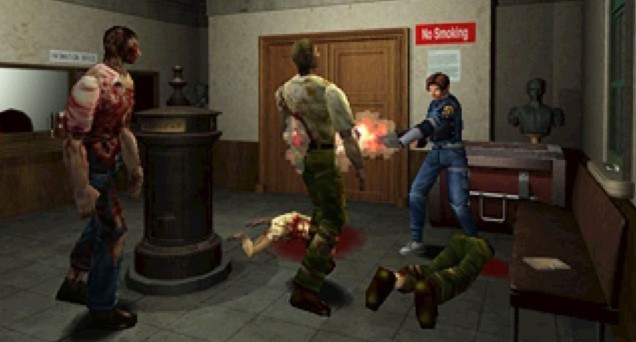
Resident Evil 2 revels in its theatricalism. It will take four playthroughs – Leon and Claire have two ‘scenarios’ each – to witness every act of the game’s melodrama. With replayability in mind, then, the pacing of each campaign is noticeably more brisk than either Jill’s or Chris’s.
 Credit: Capcom
The sequel is also less deliberately awkward. Inventory management in the original game was quite divisive. On one hand deciding which items to leave and take from storage could mean the difference between life and death – it added to the suspense. On the other, traipsing all the way back across the mansion to pick up a gemstone you left in favour of a box of shotgun shells was a pain in the backside. The same saferoom/storebox system is present, though their greater number not only reduces the amount of laborious treks, but allows you to save your game more frequently. So unless you’re chasing the highest performance ranks, it’s unlikely you’ll lose an hour’s progress after being unceremoniously decapitated. This more player friendly approach alleviates a degree of frustration, though it does come at a cost. When death has less dire consequences there will naturally be slightly less emphasis on actual survival.
Rest assured, though, Resident Evil 2 still flies the flag for survival horror. Then, with the other hand, it injects itself with a syringe full of G-Virus and mutates into something bigger and badder than before. And it only takes five minutes. It’s in these first five memorable minutes where Resident Evil 2 emphatically announces itself as a sequel. It yanks you out of the creepy halls and corridors of the Spencer Mansion and thrusts you into the middle of an undead nightmare. Out of the frying pan and into the fire. After all, if there’s one thing more frightening than being trapped all alone, it’s when the whole world’s going to hell around you.