




 |
Confrontation (PC) review"To stop all evil in the world, you control a squad of warriors belonging to the Griffin (human) faction. Though you'll recruit teammates as you travel through various lands, you can only fight with four at any given time, so you must choose your lineup carefully. You'll often be surrounded, outnumbered or overpowered. Your enemies are frequently stronger, or have better skills. It'll take your best thinking and planning to succeed." |
Prior to Cyanide's decision to develop the video game, Confrontation drew little attention to American audiences. Mainly popular in Europe, the tabletop version featured large and small-scale battles between the various factions coexisting in the world of Aarklash.
Once you understand the background behind it, the game itself suddenly makes a lot more sense. When you first boot up the campaign, the narrator's booming voice introduces each of the four factions, throwing in as much esoteric terminology as can fit in a sentence. To those of us unfamiliar with the original board game, lines like, “The Ivory Dunes, to the North of the desert of the Syharhalna... Mecasyatis clones...” I can't remember the whole line. Watch this cool trailer video instead to get the idea.
Once you get past all the fantasy jargon, you can familiarize yourself with the world, either by playing more stages or reading unlockable pages in the codex. Fortunately, any inability to understand the plot won't greatly affect your overall experience; there’s too much strategic battling to be had.
To stop all evil in the world, you control a squad of warriors belonging to the Griffin (human) faction. Though you'll recruit teammates as you travel through various lands, you can only fight with four at any given time, so you must choose your lineup carefully. You'll often be surrounded, outnumbered or overpowered. Your enemies are frequently stronger, or have better skills. It'll take your best thinking and planning to succeed.
Your original four are perhaps your strongest, especially the leader. The Officer, Darius, is built for defensive fighting. With party-boosting buffs that crank up defense and accuracy, as well as a health regenerating ability, he'll deal heavy damage against foes and can soak up hits. The scout, Lanwys, uses faith-based magic to heal the squad and remove negative effects cast by Scorpion magicians. Equipped with a pistol, he's also quite capable of fighting long-range. Though, I'll never understand why you'd want to compromise his fantastic healing abilities by keeping him near the back line.
The Inquisitor, Lothaire, exists somewhere in between a warrior and a mage, but nevertheless proves useful, immunizing squad mates against control effects like fear or paralysis. He also has a fair amount of physical strength. Combined with an area-of-effect spell that damages surrounding enemies and weakens their magic resistance, he works valiantly as a support character. Mage, Zelia, should remain in the back row slinging spells at enemies. Depending on circumstance, she can either inflict gradual damage on groups of evil clones or bind individual monsters in place. She can even sacrifice health to restore her mana when she runs low.
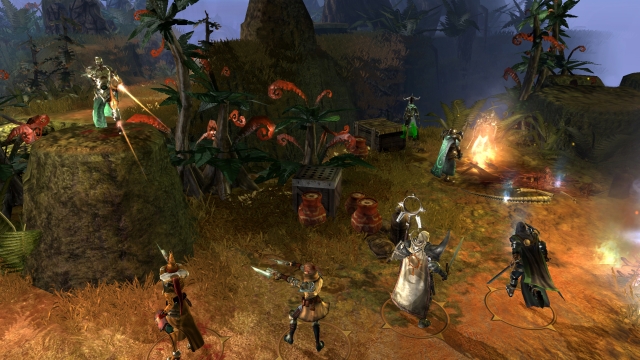
In the chaos of combat, however, things rarely go as planned. Enemies will often charge first if they see you, and if you fail to intercept them in time, they'll head straight for your rear guard. If this happens, you'll find yourself hastily trying to charge back in the hopes of distracting them long enough to keep your mages alive. Manage to avoid disaster, however, and you'll almost never lose a battle.
Except that isn't necessarily true. Even if you stick with your original four characters, you still need to plan your attacks accordingly. Winning involves more than just casting all your buffs before the start of battle; it's choosing the correct line of attack. When faced with a group of depraved sorcerers and a couple of mutated behemoths, you may have to reload your game several times to get the combination right. Enemy wizards are fond of immobilizing units and casting area darkness spells that suck the life out of your troops. So attacking them first makes the most sense. However, this isn't always easy when bulky monstrosities are smashing away at your best fighters.
If you like variety in your strategy, switching up your party will make for an even more challenging experience, especially since none of your supplementary teammates seem to have quite the same healing and buffing abilities as the nearly unstoppable pair of Darius and Lanwys. No two characters have the same set of skills, either. Some may share one or two with another, or call them different names, (such as the various ways to charge), but this doesn't take away from the fact that any combination of squad members requires its own particular strategy.
I can praise the strategic angle until the cows come home, but not to the exclusion of the game's flaws. Spotty path finding can really grow aggravating after a while. Characters travel in formation, with the leading two in front and the remaining pair taking the rear. However, if your back two characters are faster than your leads, you'll often get messages like “Darius can't reach target!” when he very well can. He's just spending too much time running into obstacles.
This is especially problematic in battle. Once, my entire group was surrounded by Scorpion genetic experiments. One of my men had already fallen, and I was trying to use Zelia to revive him because she was closest and I could not last the battle otherwise. However, because of all the chaos, I kept getting “Could not reach target!” messages despite the fact that she was literally standing right next to my injured teammate.
The terrain doesn't much allow for open combat, either. Pathways are often narrow and so cause frequent recurrences of AI failure. The rare instances you do fight in the open are quite liberating and provide your fairest shot at victory without mechanical handicaps. Constantly fighting with your own team members to get them to do what you want grows extremely tiresome. You know it's not really their fault – they do (attempt to) execute whatever command you give them; they're just hindered by faulty wiring.
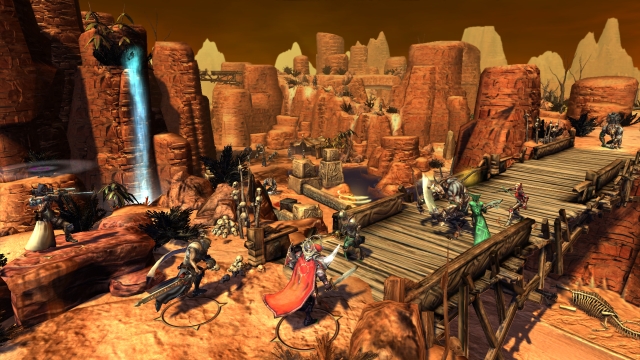
I can't say that the flaws ruin the game, but they definitely make it harder to fully enjoy. Which is a shame because strategically, Confrontation has a lot going for it. Perhaps more so than most. In addition to how you set up your commands during battle, you also have to decide how to divide attribute, skill and weapon points. For every level attained, you gain one attribute point, for every two, one skill. Weapon and armor points are found in equipment racks littered throughout a stage. Distributed wisely, your heroes become even tougher than before.
Each character specializes in three attributes, which are highlighted for your convenience. Past experiences with games of this nature taught me long ago not to try to even out my character's stats, and this I made sure to avoid here. I like to think it paid off. You upgrade skills in a similar manner, but they peak at level five. You won't have enough points to max out everything, so you still need to choose wisely which ones you focus on. The same is true for weapons and armor. Later in the game, you can insert glyphs per upgrade to enhance them even further. Balanced well, and your team will be nearly unbeatable.
In some ways, Confrontation feels like an experiment. Its frustrating flaws draw attention away from what could have been a masterpiece of a game, but it still has enough ambition to warrant a try. Strategy lovers will revel in the innumerable ways to build your team. Ambitious folks will try to find all the secrets hidden in each chapter, unlock all the achievements, and read all the lore. And even leisurely gamers will appreciate the fact that they can set the game down for days or weeks at a time and pick up where they left off without losing a step.
 | | |  |  |
 |
Freelance review by Wolf Queen (May 07, 2012)
A bio for this contributor is currently unavailable, but check back soon to see if that changes. If you are the author of this review, you can update your bio from the Settings page. |
|
More Reviews by Wolf Queen [+]
|
|

|
|

|
|

|
|
If you enjoyed this Confrontation review, you're encouraged to discuss it with the author and with other members of the site's community. If you don't already have an HonestGamers account, you can sign up for one in a snap. Thank you for reading!
 |
|
|
|
|
 |
|
|
|
|
|
|
User Help | Contact | Ethics | Sponsor Guide | Links

None of the material contained within this site may be reproduced in any conceivable fashion without permission from the author(s) of said material. This site is not sponsored or endorsed by Nintendo, Sega, Sony, Microsoft, or any other such party. Confrontation is a registered trademark of its copyright holder. This site makes no claim to Confrontation, its characters, screenshots, artwork, music, or any intellectual property contained within. Opinions expressed on this site do not necessarily represent the opinion of site staff or sponsors. Staff and freelance reviews are typically written based on time spent with a retail review copy or review key for the game that is provided by its publisher.